
GEO vs AEO vs SEO: what actually changes for online stores
Published · Updated
The short answer. SEO gets your store found on Google. GEO and AEO are two names for the next layer: getting ChatGPT, Gemini and Perplexity to recommend your products when a shopper asks what to buy. You still need SEO first. It’s the foundation. GEO is the house you build on top of it.
The three names, in plain English
When a store owner asks me what GEO is, I tell them it stands for generative engine optimization. But what it really means is having the right content about your brand in a way that ChatGPT, Perplexity and Gemini can easily pick up. So when someone asks for a certain feature, a certain price or certain qualities, and those match your product, the AI can recommend your product as the one that solves that for them.
AEO stands for answer engine optimization. For a store, it’s the same job with a different label. You’ll hear agencies use one or the other, or both. It doesn’t really matter which word they use.
| SEO | GEO / AEO | |
|---|---|---|
| What it’s for | Ranking your pages on Google | Getting AI to recommend your products |
| Where it shows up | Google results | ChatGPT, Gemini, Perplexity, Google’s AI answers |
| What it needs from your store | Crawlable pages, good content, links, reputation | All of that, plus clear product details AI can match to a shopper’s question |
| How you know it’s working | Your rankings, and the clicks you get from Google | How often AI recommends you over competitors, and whether what it says about you is right |
SEO is the foundation
Is SEO still worth it? Yes. It’s extremely important. It’s the foundation that needs to be in place before GEO even makes sense.
Here’s why. AI wants to pull its answers from trusted sources. Sources with a decent, long-standing reputation. And it wants several of them backing the same answer, so the answer feels safe to give.
So think of SEO as the foundation. Once that’s in place, you start building the house itself. That’s where GEO, or AEO, or whatever acronym you want to use, comes in, and where you start optimizing for the way people actually talk to AI. But you still need the SEO, because a lot of the time the articles, reviews and pages AI trusts are the reason AI picks your brand in the first place.
AI recommends your product
The house · GEO / AEO
- Answers to the questions buyers ask
- Product details AI can match
- Being mentioned where AI looks: reviews, Reddit, YouTube
The foundation · SEO
- Crawlable pages
- Clean product data
- Structured data
- Reputation and reviews
What changed
Traditionally, you’d go on Google, type in what you’re looking for, and click through the first page or two. The sites that ranked, or the paid ads at the top.
Now people search inside a chat. A lot of them never reach your website. They see the products the AI picks. Even on Google, the AI summary at the top is now more powerful than ranking first.
And one question isn’t one search anymore. Behind the scenes, AI splits a shopper’s question into several smaller searches. So ranking for one keyword isn’t enough. You need to show up for all the little questions sitting behind the big one.
That’s why I started Mercenta. I was already advising brands, and I could see this shift coming. When it came to e-com, I wanted to properly understand how AI chooses, so I could help brands and their products be the ones it picks.
What AI actually does when someone shops
What surprised me most was how smart it is.
Say you’re looking for noise-canceling headphones that are waterproof. It might ask what you’re using them for. You say the gym. Then you mention you have a Samsung phone. All of a sudden it’s mostly showing you Samsung products, because they’re the most compatible. That doesn’t mean they were the best option for you.
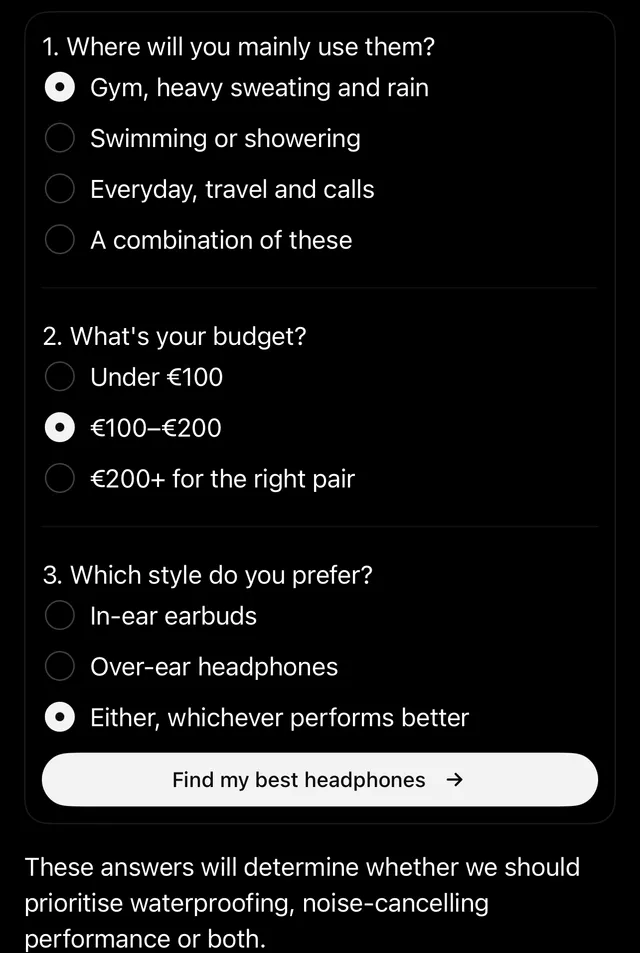
“Where will you mainly use them?” Gym, heavy sweating and rain. “What’s your budget?” €100–€200. “Which style do you prefer?” Either, whichever performs better.
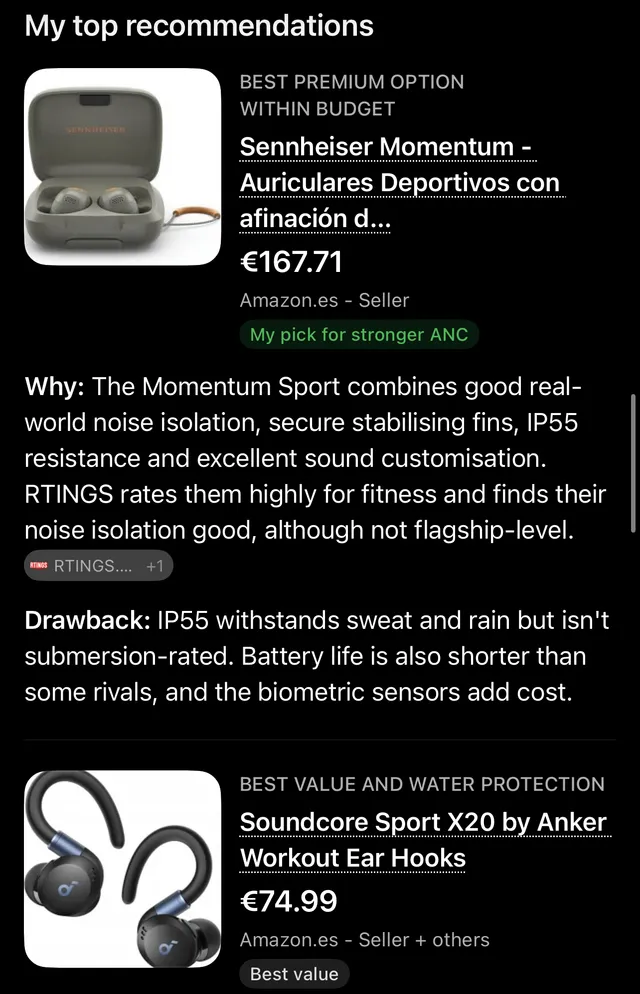
“My top recommendations”: Sennheiser Momentum Sport, €167.71, “my pick for stronger ANC”. Soundcore Sport X20 by Anker, €74.99, “best value”.
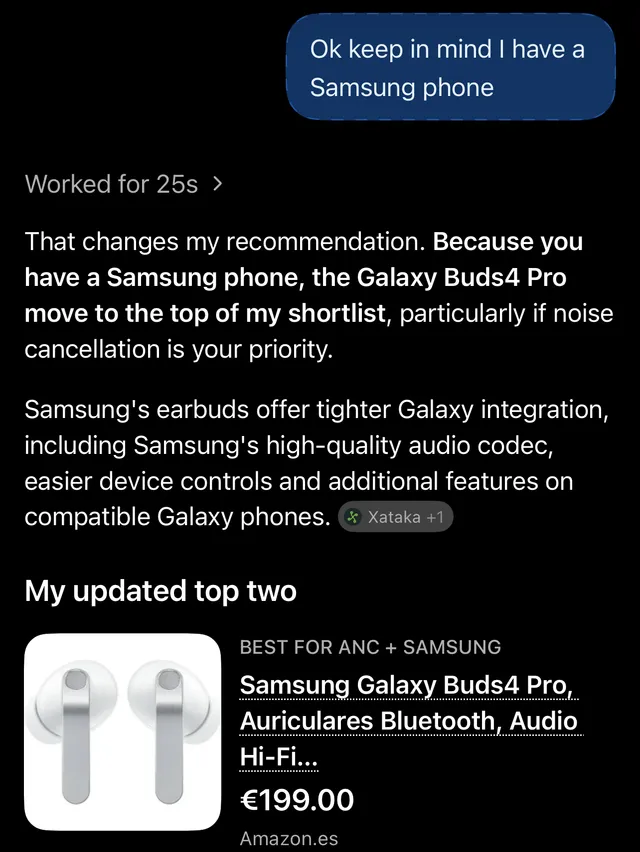
“Ok keep in mind I have a Samsung phone”. ChatGPT: “That changes my recommendation. Because you have a Samsung phone, the Galaxy Buds4 Pro move to the top of my shortlist.” Samsung Galaxy Buds4 Pro, €199.00.
So ecosystems matter. And AI doesn’t decide from one question. It gets there over several. Along the way it might offer you products that aren’t the best for you, just the best known: the ones with the most citations and information it can draw from.
And it’s not only AI asking the questions. Your potential customers ask questions too. They’re having conversations, trying to make informed purchases. If your product isn’t included in those early conversations, you won’t be considered.
What’s different when you sell products
Most of the advice out there is about the whole brand. Is your brand known? Is it mentioned? Is it trusted? That matters. But if you sell products, that’s only the start.
When a shopper asks AI what to buy, it looks at the product itself. And what it looks at depends on the questions in that conversation: the ones your potential customer asks, and the ones AI asks back. Things like:
- Do you deliver to where they are?
- Is it in stock?
- What’s the warranty?
- Does it come in their size? Will it fit?
- Does it work with what they already own? (The Samsung example above.)
1Shopper asks
“Best waterproof noise-canceling headphones?”
2AI asks back
- “What will you use them for?”Gym
- “What’s your budget?”
- You mention: I have a Samsung
3AI checks each product
- In stock?
- Delivers to you?
- Warranty?
- Fits / works with your phone?
4Two or three products recommended
Products whose pages don’t answer these drop out.
There are loads more. Every answer the shopper gives changes which products make the cut. If your product page doesn’t answer those questions clearly, AI can’t match you to them, and it picks someone whose page does.
And every industry has its own questions. Someone buying a suitcase gets asked if it fits in the overhead bin and how much it weighs. Someone buying skincare gets asked about their skin type. Someone buying a sofa gets asked about the size of their room and when they need it delivered. Your pages need to answer the questions that matter in your industry first.
Then it goes down to each product. Two products from the same brand can win or lose for completely different reasons. One gets picked for its warranty, the other gets dropped because the page never says what sizes it comes in. Each product needs its own differences spelled out.
So this isn’t a small job. It’s every question your buyers ask, and get asked, across every product you sell, and it keeps moving as the AI changes.
OpenAI says its shopping research reads retailer pages for price, availability, reviews and specs before it recommends anything.
That’s why we do the brand and the products. Most agencies stop at the brand. Working product by product is a whole other level.
Being read isn’t being picked
AI can read your page and still not use it. It reads a lot of pages, but it only quotes a few. The ones it quotes have clear, structured facts it can lift straight out.
So your product page has to say things plainly: specs, sizes, warranty, delivery. And the places AI does quote, like review sites, Reddit and YouTube, need to be talking about you too.
Why most of the advice out there isn’t for you
When agencies pitch AEO or GEO, the first thing they get wrong is underselling SEO. You could be as optimized for AI as you like, but without that foundation you probably won’t get the results.
The second thing is selling something they don’t fully understand. There’s no exact science here. You could ask the same question 10 times and get 7 different answers. There are patterns, but you only see them with a lot of data, looked at properly. Why did it pick that answer? Does it change depending on where the person is, what’s in stock, or what they were asked first? Without that, it’s very hard to know if what you’re doing is working. So you get the surface-level pitch: “we’ll get you ranked number one”. Promises nobody can back up.
What to do this week
If you’ve got one hour, do two things.
1. Make sure AI can get into your site. Check that AI and bots can actually crawl your store, and that your product data is as clean as possible. Check your robots.txt and your firewall settings (Cloudflare and some apps block bots by default) aren’t shutting out AI crawlers such as OAI-SearchBot and PerplexityBot. Make sure price, stock, sizes and materials are written on the product page as text, not only in images. There are free scans that show you this. We have one at mercenta.ai, and it’ll at least tell you whether AI can draw any conclusions from your products.
2. Ask AI about yourself. Go to ChatGPT, or whichever AI you use, and type in your brand and the name of your shop. See what it knows. Make sure it’s correct and nothing’s out of date.
Is it just hype?
People said that about the internet. They said it about Google, and about building up your content online.
Every now and then the way we do things changes. And we’ve never had this much intelligence in our pockets before. People will use it more and more. Right now the number of people using AI is small compared to what it will become, and that’s the opportunity. It’s still underserved.
You don’t have to believe the hype. But trust me, your competition does. Look at every time the way people find information, or the way advertising works, has changed. The ones who moved early got the best seat. The ones who came late sat at the back, or paid a lot of money to take a seat someone else got for free.
Who should care?
Honestly, I can’t think of a business that shouldn’t. If you sell anything online, and you have reviews and competitors, this is for you. If being found on Google ever mattered to you, this matters more, because it’s changing how people use Google in the first place.
FAQ
Is GEO replacing SEO?
No. SEO is the foundation GEO sits on. Without it, AI has less reason to trust you.
Is AEO the same as GEO?
For an online store, yes, more or less. Two labels for the same goal: being the product AI recommends.
Do I need a GEO agency?
You can start on your own with the two things above. But don’t stop there. Even if AI recommends you today, that position isn’t safe. The answers change all the time, and if you’ve got no strategy in place, a competitor who has one can take your spot. Whether you’re being picked or not, someone needs to be defending or winning that position every week.
How do I know if AI recommends my products?
Ask it the questions your customers would ask, in a few different ways, and see who comes up. Or run a free check at mercenta.ai.
About me
I’m Nick Acquah, founder of Mercenta. We only work with e-com brands, and we do one job: get your products recommended by AI over your competitors’, so you make more sales.
Want a team on it every week? See our AEO service